When someone in Boynton Beach grabs their phone and types “AC repair near me” or “best roofer in Delray Beach,” they’re not browsing. They need someone, usually today. The businesses that show up in that moment get the call. Everyone else might as well not exist.
That’s what local SEO is: making sure your business shows up on Google Search, Google Maps and now AI tools like ChatGPT when nearby customers are ready to buy. And those customers move fast. BrightLocal’s 2026 Consumer Search Behavior study found that 84% of consumers searched for a local business in the past three months, 72% look at three or fewer businesses before deciding, and 75% make their choice in under 30 minutes. Nearly half (46%) say they always or often add “near me” to their searches.
This guide walks you through exactly how it works in 2026, step by step, using the latest research and what we see every day running local SEO for our clients.
The short version
- Claim and fully complete your Google Business Profile. It’s the biggest single lever you have.
- Make your website back it up with local pages, consistent details and fast mobile pages.
- Earn a steady stream of fresh reviews and reply to every one of them.
- Keep your name, address and phone the same on every directory, including Apple Maps.
- Do these well and you also improve your chances in AI search answers.
How Google Decides Which Local Businesses to Show
Google is open about the basics. Its own Business Profile help pages say local results are based mainly on three things: relevance (how well your business matches the search), distance (how close you are to the searcher) and prominence (how well known and trusted your business is).
The details come from the industry. Every year, Whitespark’s Local Search Ranking Factors survey asks dozens of top local SEO experts to weigh the signals. The 2026 edition, with 47 experts rating 187 factors, breaks down the map pack like this:
The single most important factor is your primary Google Business Profile category, followed by how close you are to the person searching. One newer factor surprises many owners: whether you’re open at the time of the search now ranks in the top five. Accurate hours really do matter.
You can’t move your building closer to every customer. You can control almost everything else, so let’s go through it.
Step 1: Set Up and Fully Complete Your Google Business Profile
Your Google Business Profile (GBP) is the listing that shows up in Google Maps and the map pack, with your hours, reviews, photos and that all-important “Call” button. It’s free, and it’s the closest thing local SEO has to a shortcut. Yet many small businesses still haven’t claimed theirs, or claimed it years ago and never touched it again.
Here’s the checklist we use when we set one up or clean one up:
- Claim and verify the profile at business.google.com. Use an email you control long term, not a former employee’s or an old agency’s.
- Pick the right primary category. This is the number one ranking factor, so be specific. “Roofing contractor” beats “contractor.” Add secondary categories for other real services.
- Use your real business name. Don’t stuff keywords like “Best Plumber Boynton Beach” into the name. It breaks Google’s guidelines and can get your profile suspended.
- Set accurate hours, including holiday hours. Being open when someone searches now affects rankings.
- Add every service and your service area, with short, plain descriptions.
- Upload real photos of your team, work, vehicles and location. Stock photos don’t build trust.
- Write a clear description that says what you do, who you serve and where.
- Add booking, quote or appointment links so people can act right away. (Google retired Business Profile chat in 2024, so calls and links are what count now.)
- Post updates regularly: offers, recent projects and seasonal tips. An active profile signals an active business.
Quick check: search your business name on your phone. If your hours, phone number or website link are wrong anywhere, fix those first. Small errors cost real calls.

Step 2: Make Your Website Back Up Your Profile
Google cross-checks your profile against your website. On-page signals make up about 15% of map pack ranking weight, and they matter even more for the regular organic results below the map. A weak website holds back a strong profile.
- Consistent NAP. Your name, address and phone number should match your profile exactly, ideally in the footer of every page.
- A page for every main service, not one page that lists everything. “Roof repair” and “roof replacement” deserve their own pages.
- Location pages for the areas you serve, written for real people with real local details. Our own Boynton Beach web design page is an example.
- LocalBusiness schema markup so search engines and AI tools can read your details reliably.
- Fast, mobile-first pages with a tap-to-call button near the top.
- Proof: reviews, project photos, certifications and case studies on the page.
This is where on-page SEO and technical SEO come in. If your site is slow, hard to use on a phone or missing basic structure, fix that before spending money on anything else. If you’re weighing a new site, our guide to what a website costs in 2026 covers your options.
Step 3: Get More Google Reviews, and Keep Them Coming
Reviews are the second-heaviest local ranking signal, and they’re what customers actually read before they call. BrightLocal’s 2026 Local Consumer Review Survey of 1,002 US adults shows how much the bar has risen:
BrightLocal’s headline for 2026 says it all: ratings keep rising, and old reviews don’t cut it. A business with 150 reviews, the latest from 2023, can lose to a competitor with 40 reviews from the last few months. Recency counts.
How to get more Google reviews (the right way)
- Ask at the right moment, right after a job is finished and the customer is happy, not two weeks later.
- Make it one tap. Send your direct Google review link by text or email, and put a QR code on invoices, receipts or your counter.
- Follow up once if they don’t leave one. A friendly reminder a couple of days later works well.
- Reply to every review, good and bad, within a few days. Future customers read your replies too.
- Automate the asking. Our AI lead follow-up and email automation can send review requests automatically after each job.
Never buy reviews or offer rewards for 5 stars. The FTC’s rule against fake reviews took effect in 2024 and allows penalties, and Google removes suspicious reviews in bulk. It’s also against Google’s policies to only ask happy customers (called “review gating”). Ask everyone, and handle complaints well.

Step 4: Get Listed Everywhere Customers Look
Google is still the biggest place people check, but it’s no longer the only one. BrightLocal found consumers now use an average of six different review sites, and the mix is shifting fast:
Apple Maps nearly doubling is the one most local businesses miss. Every iPhone user who asks Siri for directions sees Apple’s data, not Google’s. Make sure your business is claimed and accurate on these:
- Apple Business Connect (Apple Maps and Siri)
- Bing Places, which also feeds some AI assistants
- Yelp, Facebook and the BBB
- Your local chamber of commerce and industry directories, like Angi or Houzz for home services
The rule is simple: the same business name, address, phone number and website, written the same way, everywhere. Inconsistent listings confuse search engines and AI tools alike.
Step 5: Build Local Content and Local Links
This is the part most competitors skip, which is exactly why it works. Google rewards businesses that are clearly part of their community.
- Write about real local work. A project page like “New roof in Lake Worth Beach after the 2026 storm season” beats a generic “We do roofs” page.
- Answer the questions customers ask you on the phone. Each good answer can be a page or a blog post. Our SEO content writing service does exactly this.
- Earn local links from sponsorships, local news, partner businesses, suppliers and community groups. One link from a respected local site is worth more than dozens of random directories.
What This Looks Like in Practice: A Real Local SEO Result
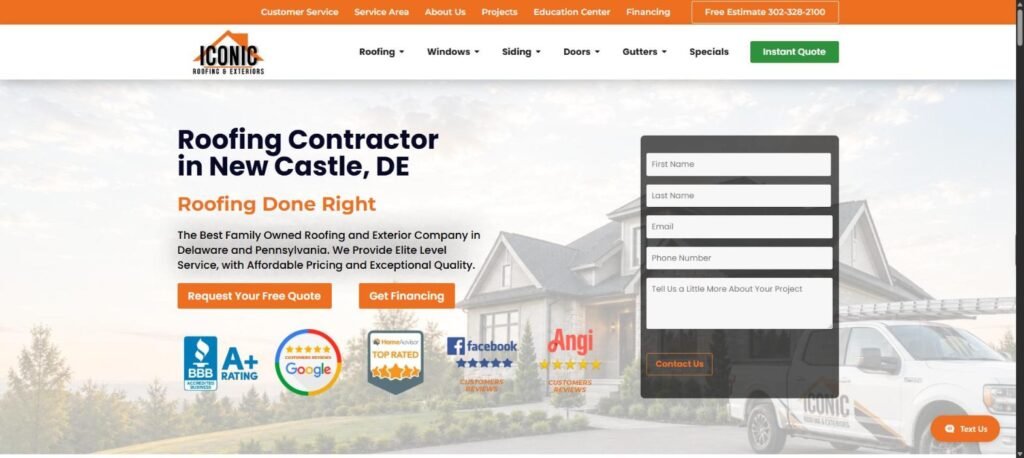
Theory is nice. Here’s what happened when we applied it for Iconic Roofing & Exteriors, a roofing contractor in Delaware that was stuck on page four of Google for the searches that bring in roof replacement and repair jobs.
We optimized their Google Business Profile, built city service pages, ran a steady review program, improved their Maps visibility, earned local links and added storm-damage and free-estimate messaging. Then we kept managing the site and the SEO every month.
For Tricon Construction Management, a firm serving Delaware, Pennsylvania, Maryland and New Jersey, a full technical, local and content SEO program more than doubled Google impressions (+103%), grew clicks 105% and moved the average position from 44 to 29. Neither business got there with tricks, just the steps in this guide done consistently.
Local Search Now Includes AI. Here’s Why That’s Good News
The biggest change in local search this year isn’t on Google. BrightLocal found that 45% of consumers now use ChatGPT or other AI tools to find local businesses, up from just 6% a year earlier. That’s the fastest shift in local search behavior the survey has ever recorded.
Google itself is changing too. A 2026 Whitespark study of 540 local searches found AI Overviews appearing on about 68% of local business queries on average.
The good news: AI tools lean on the same signals covered above, including your Google Business Profile, reviews, directory listings and clear website content. Businesses that do local SEO well are the ones AI tends to recommend. We go deeper on this in our guide to showing up in ChatGPT and AI search, and it’s the focus of our AI search optimization service.
How Long Does Local SEO Take, and Is It Worth It?
It’s the question we hear most from owners weighing the cost, and it’s a fair one. For what it’s worth, marketers still rank their website, blog and SEO as the number one channel for return on investment, according to HubSpot’s 2026 State of Marketing report. Here’s what we tell clients honestly about timing:
- Weeks: fixing your Google Business Profile, categories, hours and listings can move map rankings within a few weeks.
- 3 to 6 months: competitive keywords, new service pages and a growing review count usually take this long to show steady gains.
- 6 to 12 months and beyond: this is where local SEO compounds. Rankings, reviews and content keep working without paying per click.
Compared with ads, where traffic stops the day you stop paying, local SEO builds an asset you keep. Most businesses do best with both: Google Ads for immediate leads while SEO builds up underneath.
6 Local SEO Mistakes We See All the Time
| Mistake | Why it hurts | The fix |
|---|---|---|
| Wrong or vague primary category | It’s the #1 map pack factor | Choose the most specific category that fits |
| Keywords stuffed in the business name | Risks suspension | Use your real, legal business name |
| Outdated hours | Being open at search time affects ranking | Update regular and holiday hours |
| No reviews in months | Customers and Google want recent ones | Ask after every job, automatically |
| Different phone numbers online | Confuses Google and AI tools | One NAP, used everywhere |
| One page for all services | Nothing ranks well | One focused page per service and area |
Should You Do Local SEO Yourself or Hire Help?
You can absolutely do the basics yourself. Claiming your profile, fixing your hours, asking for reviews and listing yourself on Apple Maps cost nothing but time. If you’re a one-person business in a quiet market, that may be all you need.
It makes sense to bring in help when your competitors are clearly investing, when you serve several cities, when your website needs work, or when you simply don’t have the hours. That’s when a structured local SEO program, with monthly reporting on calls, clicks and rankings, pays for itself.
Find out where you stand on Google
We’ll check your Google Business Profile, reviews, listings and website, and show you exactly what’s holding you back. Free, with no obligation.
Frequently Asked Questions
Create and verify a free Google Business Profile at business.google.com, choose the right primary category, add your hours, services, photos and service area, and link it to your website. Most businesses can be visible on Google Maps within a few days of verification.
Local SEO is the work of helping a business show up when nearby customers search, in the Google map pack, Google Maps, regular search results and, increasingly, AI tools like ChatGPT. It covers your Google Business Profile, reviews, website, directory listings and local content.
Choose the most accurate primary category, complete every section of your Google Business Profile, keep your hours accurate, earn a steady flow of fresh reviews, keep your business details consistent everywhere, and make sure your website has strong service and location pages.
Ask every customer right after the job, send your direct review link by text or email, use a QR code on invoices or at the counter, follow up once, and reply to every review. Never buy reviews or only ask happy customers.
Profile and listing fixes can move map rankings within a few weeks. Competitive keywords usually take three to six months of steady work, and results keep compounding after that.
Yes. AI tools rely heavily on the same signals: your Google Business Profile, reviews, directory listings and clear website content. Strong local SEO is the foundation of AI search visibility.
Sources
- BrightLocal: Local Consumer Review Survey 2026
- Whitespark: 2026 Local Search Ranking Factors
- BrightLocal: Consumer Search Behavior 2025 and 2026 (local SEO statistics)
- HubSpot: State of Marketing Report 2026
- Google Business Profile Help: How Google determines local ranking
- Client results: Google Search Console, Oct 2025 to Sep 2026 vs Oct 2024 to Sep 2025