Here’s a conversation we have almost every week in Boynton Beach: “Why would I pay a web designer when an AI website builder can make me a site in five minutes?” Honestly? Sometimes you shouldn’t. And sometimes that five-minute site quietly costs you more than a professional one ever would.
This guide skips the sales pitch. We’ll walk through 7 honest differences between an AI website builder and a real web designer, what each one costs, and a quick way to figure out which one fits your business right now.
The short answer
- Pick an AI website builder if you need something online fast, you’re testing an idea, or the site is mostly a digital business card.
- Hire a web designer if your website needs to bring in calls, quotes, bookings or sales, especially from Google.
- Either way, own your domain, keep it fast on phones, and make it easy to contact you.
Why Everyone’s Talking About AI Website Builders
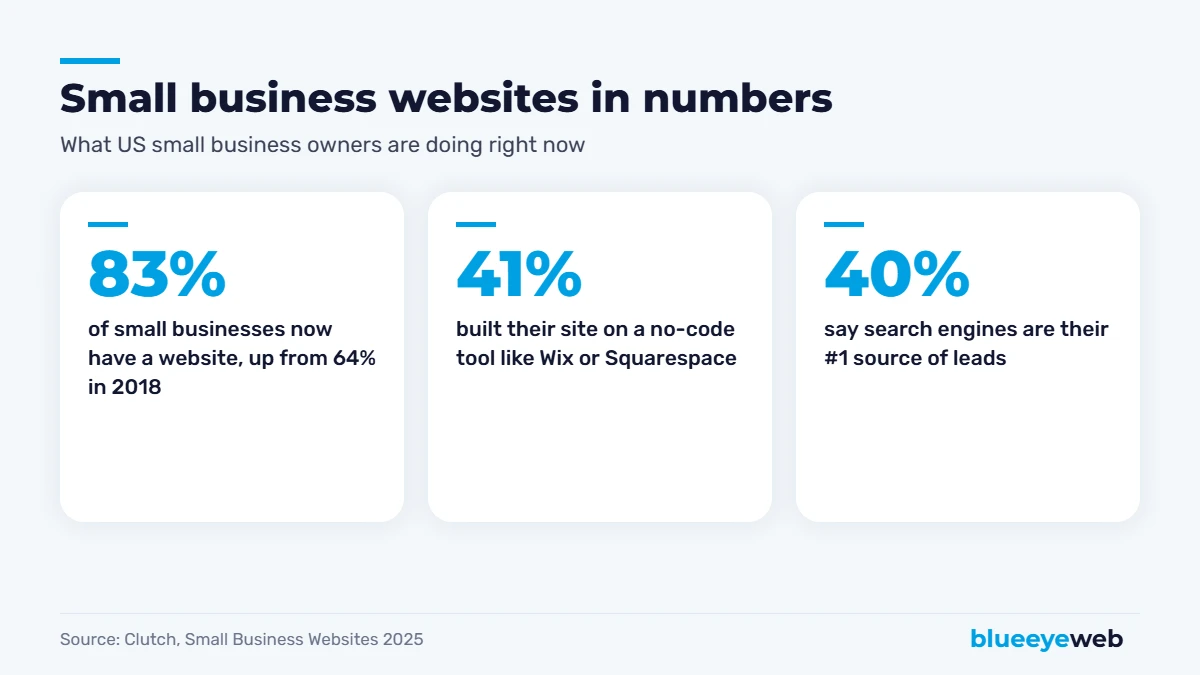
Building a site has never been easier. According to Clutch’s 2025 small business website survey, 83% of US small businesses now have a website, up from 64% in 2018, and 41% built theirs on no-code tools like Wix or Squarespace. Clutch credits a lot of that growth to cheap builders and AI features.
An AI website builder works like this: you describe your business in a sentence or two, and it spits out pages, colors, stock photos and placeholder text. Wix, Squarespace, Hostinger and others all have one now. It feels like magic the first time you try it.
The question isn’t whether an AI website builder can make a website. It obviously can. The question is whether that website will do the job you need it to do.
7 Honest Differences Between an AI Website Builder and a Web Designer
1. Speed: minutes vs weeks
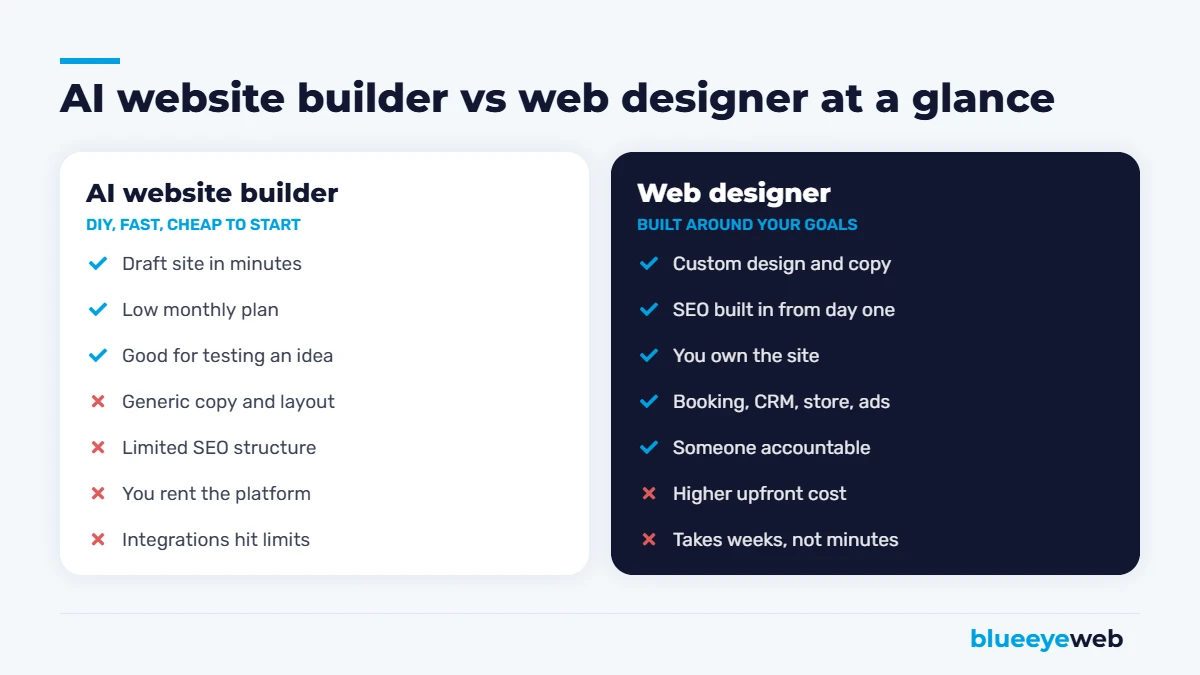
No contest here. An AI website builder gets you a live draft in minutes. A designer takes a few weeks, because they’re planning pages, writing copy, building and testing. If you need something online by Friday for a grand opening, AI wins.
2. Upfront cost: cheap vs an investment
Builder plans run roughly $17 to $159 a month on Wix, and Squarespace sits in a similar range. A professional site is a bigger check upfront. Ours start at $1,500 for a small site and $3,000 for our most popular package. But compare the total over three years, including your own hours, and the gap shrinks fast. We break down every cost in how much a website costs in 2026.
3. Content: generic vs written for your customers
This is the big one. AI-written pages tend to sound like every other AI-written page. Words like “elevate,” “seamless” and “your trusted partner” don’t sell roofs or root canals. Customers want specifics: what you do, where, for how much, and why you’re the safe choice. In BrightLocal’s 2026 consumer research, clear and complete information, the best reviews and clear pricing were the top three things people weighed when deciding which local business to contact.
4. SEO: a template vs a plan
An AI website builder can add a page title and a meta description. What it won’t do is research how people in Palm Beach County actually search for your service, map those searches to pages, set up schema markup, plan internal links and make sure every page loads fast on a phone. Clutch found 40% of small businesses with a website say search engines are their top source of leads, so this matters more than the color scheme.
5. Ownership: renting vs owning
On most hosted builders, you rent your site. If you outgrow the platform, you can’t take the design with you. A designer building on WordPress gives you a site you own and can move to any host. (We compare the platforms in WordPress vs Wix vs Squarespace.)
6. Integrations: basic vs whatever you need
Booking calendars, CRMs, payment systems, inventory, ShipStation, Google Ads tracking, AI chat assistants. An AI website builder covers the basics through its app store, then hits a wall. A designer connects what your business actually runs on.
7. Accountability: you vs someone else
When an AI-built site breaks, slows down or stops sending form emails, you’re the support team. With a designer and a care plan, someone else gets the 7 a.m. call. That peace of mind is worth more than most people expect.
When an AI Website Builder Is Actually the Right Call
We’re not going to pretend AI builders are bad. They’re great tools in the right situation:
- You’re testing a new idea and want to see if anyone bites before you invest.
- You need a one-page placeholder with your phone number while a real site is being built.
- It’s a hobby or side project where leads and rankings don’t really matter.
- Your budget is truly zero right now. Something is better than nothing.
Pro tip: if you start with an AI website builder, register your domain separately (in your own name), and write your own “About” and service text. That way you keep the two most valuable parts when you upgrade later.
When You Really Need a Web Designer
On the other hand, an AI website builder usually isn’t enough when:
- Your phone rings because of Google. Local service businesses live or die on search visibility, and that takes real local SEO structure.
- You sell online. Product catalogs, shipping rules, taxes and checkout need careful setup. That’s what our e-commerce websites are built for.
- You run ads. Paid clicks are expensive, so the page they land on has to convert. See landing pages.
- You need integrations with booking, CRM or business systems.
- Your brand needs to stand out in a crowded market like South Florida.
The Hidden Costs of a “Free” AI Website
An AI website builder looks cheap on day one. Here’s where the costs sneak in:
| Hidden cost | What it looks like |
|---|---|
| Your time | Hours writing copy, fixing layouts and figuring out settings instead of running your business |
| Upgrades and apps | Removing ads, adding bookings or a store, and paid apps that each add a monthly fee |
| Lost leads | A slow, generic site that doesn’t rank or convert. You never see these customers, which is why they’re easy to ignore. |
| The rebuild | When you outgrow the platform, you pay for a new site anyway, and risk losing rankings if URLs change |
Speed is a good example. The HTTP Archive’s 2025 Web Almanac found only 48% of mobile websites pass Google’s Core Web Vitals. Template-heavy builder sites often land in the other half, and slow pages lose both rankings and visitors.
A Middle Path: AI-Assisted, Human-Led
Here’s what we actually do at BlueEyeWeb: we use AI where it saves time and use people where it counts. AI helps with first drafts, research and repetitive tasks. A human plans the structure, writes the parts that sell, checks every fact, and builds the site properly on WordPress.
You get the speed benefits of AI without the generic result. And you can add AI to the finished site itself, like an AI website assistant that answers questions at 10 p.m. or instant lead follow-up that replies to new inquiries in seconds.
How to Decide in 5 Minutes
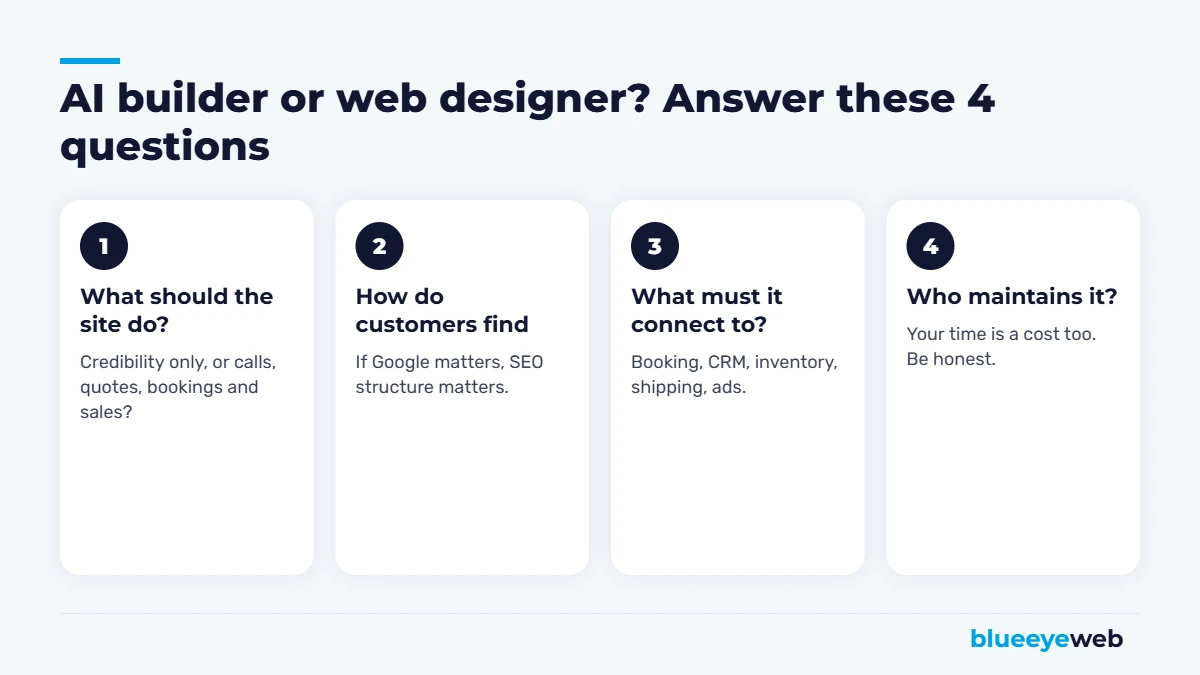
- Write down what the site must do. “Look legit” is different from “bring in 10 quote requests a month.”
- Check how customers find you. If it’s Google, plan for SEO from day one.
- List the tools it has to connect to. Booking, CRM, payments, shipping.
- Be honest about your time. Will you really update it every month?
- Compare 3-year cost, not month 1. Include your hours and the cost of a future rebuild.
If most of your answers point to leads and growth, a designer is the better investment. If they point to “just get something online,” an AI website builder is a fine place to start.
3 Real-World Scenarios: Which Would You Pick?
Let’s make this concrete. Here are three typical businesses we talk to around Boynton Beach and Palm Beach County, and what we’d honestly tell each one.
The new landscaping crew
Two trucks, a great reputation from word of mouth, and a Facebook page. They want “something on Google” before spring. Our advice: start with a solid Google Business Profile first, because that’s where local customers look. An AI website builder is fine for a simple one-page site for the first few months, as long as the phone number is big and tappable. Once the calls pick up and they want to rank for “lawn care Boynton Beach,” it’s time for a real site with service and area pages.
The boutique opening an online store
A shop in Delray Beach with 300 products and plans to ship nationwide. This is where an AI website builder starts to struggle: product variants, shipping rules, sales tax, inventory syncing and product SEO all need careful setup. A professionally built WooCommerce or Shopify store pays off quickly here.
The consultant who sells on trust
A one-person financial or business consultant. They don’t need 40 pages, but they do need to look credible and show up when people search their name and specialty. A small custom site with real case studies, a clear offer and a booking link usually outperforms a generic template, because trust is the whole sale.
Questions to Ask Before You Hire a Web Designer
If you decide to go the professional route, these questions will save you a lot of headaches:
- Who owns the site, domain and content when we’re done? The answer should be “you.”
- Is copywriting included, or do I write everything? Many cheap quotes leave this out.
- What SEO is included at launch? Look for page titles, structure, schema markup, redirects and Google Search Console setup.
- How fast will it load on a phone? Ask for a speed check before launch.
- What happens after launch? Updates, backups and security need an owner. Our guide to website maintenance costs explains what to expect.
- Can I see results, not just designs? Real numbers matter more than pretty screenshots.
A good web designer will be happy to answer all of these. If someone dodges them, that’s your answer too.
Where AI Website Builders Are Headed
AI website builders will keep getting better at layouts and first drafts, and that’s good news for everyone. It means the “blank page” problem is basically solved. What won’t change is that customers choose the business that’s clearest, most trusted and easiest to contact. That still takes knowing your market, your customers and your numbers, which is exactly where people make the difference.
So use AI as a tool, not a strategy. The best results we see come from businesses that combine both.
Not sure which way to go?
Send us your current site (or your idea) and we’ll give you an honest recommendation, even if that’s “use an AI builder for now.”
Frequently Asked Questions
It can be for a simple online presence, a new idea or a placeholder page. If your business depends on Google rankings, leads or online sales, an AI website builder usually falls short on unique content, SEO structure, integrations and ownership.
Most AI website builders are included in website builder plans. On Wix, plans run roughly $17 to $159 a month on annual billing, and add-ons like bookings, stores and apps can add more.
It can rank for easy, low-competition searches. For competitive local searches, you usually need custom content, proper page structure, schema markup, fast mobile pages and ongoing local SEO, which builders do not plan for you.
AI is changing how websites are built, and good designers use it every day. What it does not replace is strategy, original content, conversion planning and someone accountable for results.
Yes, but you usually cannot move the design. Your content and domain can move, and a careful migration with 301 redirects protects your rankings.
At BlueEyeWeb, small business websites start at $1,500, our most popular package is $3,000, and larger sites and online stores start at $8,000. Every project starts with a free audit and a fixed-price quote.
Sources
- Clutch: Small Business Websites in 2025
- BrightLocal: Consumer Search Behavior 2026
- HTTP Archive: Web Almanac 2025, Performance
- Wix and Squarespace public pricing, 2026